This is default featured slide 1 title

Go to Blogger edit html and find these sentences.Now replace these sentences with your own descriptions.

This is default featured slide 2 title

Go to Blogger edit html and find these sentences.Now replace these sentences with your own descriptions.

This is default featured slide 3 title

Go to Blogger edit html and find these sentences.Now replace these sentences with your own descriptions.

This is default featured slide 4 title

Go to Blogger edit html and find these sentences.Now replace these sentences with your own descriptions.

This is default featured slide 5 title

Go to Blogger edit html and find these sentences.Now replace these sentences with your own descriptions.

Monday, October 17, 2011

Buddha was born in Nepal,not in India


  When i was a kid, my teachers used to say that Lord Gautam Buddha was born in Lumbini district of Nepal. I still remember when i was in 4 grade there was a biography of Buddha in my social studies book and it was very interesting one. I was always curious to know more about Gautam Buddha as i am from a Buddhist family and still the hunger to know about him inside me is not completed yet.

So the title above is the one i want to flash out all over the world and i hope my blog readers will help me.
Damn how come the Indians say Gautam Buddha was born in Indian? but i can do nothing :'( . Every time we are dominated and our government is not aware about it.
  • They said Gautam Buddha was born in India. is that true?
  • The Great Indian One horn Rhino shown in Discovery.Who gave them One horn rhino ?
  • Why the Indian Barracks inside the  Nepal borders in the east ??  
We all know every thing but we can't do anything. Just sit and watch our national political fight among political parties and who knows what happens. 

Watch Video Clip


    Gautam Buddha Birth Place
  
Source : http://www.gautambuddha.net

      It stated that Gautam Buddha was born two hundred years before King Ashoka reign. Birthplace of Gautam Buddha is regarded as Lumbini in Nepal. It is said that when his pregnant mother Maya was leaving Kapilvastu to deliver Gautama at her father’s place she gave birth to a beautiful child in the gardens of Lumbini below the sal tree. The child was named Siddhartha who later on came to be known as Gautama Buddha. It was hermit Asita who declared that the child would either become a great king or a holy man.


The birthplace of Gautam Buddha is situated on the foothills of Himalaya in the kingdom of Nepal and the day on which Siddhartha Gautam was born is celebrated as Vesak. King Ashoka visited the Lumbini forest and constructed four stupas and stone pillars with horse figure on top of it.
Lumbini, the birthplace of Gautam Buddha remained neglected for centuries before a German archaeologist discovered the famous pillars in 1895 in the foothills of Churia range and on further excavation a brick temple and sandstone sculpture was discovered within the temple which depiction of Buddha’s birth.

On the south of the Maya Devi Temple is Puskarni which is the famous sacred bathing pool and it stated that Maya Devi took a bath in this pool before delivering the baby. I 1996 a flawless stone placed by Emperor Ashoka was discovered which was placed in 249 BC to mark the birth of Buddha 2,600 years ago.

A visit to the birthplace of Gautama Buddha not only leads to spiritual enlightenment but also brings peace in life.


What you think about this post?

Sunday, October 16, 2011

Creative Girl with Nepali Song

Creative Girl showing how she feels about her boyfriend in Nepali Song


GXSOUL Feat. C.O.D - Raat Vari (Official Music Video)


GXSOUL Feat. C.O.D - Raat Vari (Official Music Video) from sanzip rai on Vimeo.
Official music video for GXSOUL Feat. C.O.D performing 'Raat Vari' from the album Gorkhali Extreme Marketed by Superstar Ent.

Directed, Shot & Edited by Sanzip Rai
Asst. Director: Bidhan (C.O.D)

2nd Asst. Camera: BJ Gurung (Shoot1st)
Canon 7D/550D t2i
Sigma 50mm f1.4
Canon 50mm f1.4


---------------LYRICS-----------


Yo raat maa,adhyaaromaa haami sangai sangai,
Juna haru jiskauda chhan,jaba Hidda Chau haami haat samai..

(CHORUS)2x
RAAT yo nabitos na ta yo saath chutoss,
Maya nai maya hossh,yo raat vari

(Viber Bi)
yeah..allright..c'mon-
you got me feelin' like i got no beat in my heart,
you turn around look at me, my heart beat stops,
you are a state of art, a creation of perfection,
a beauty of design, my mind into you,
you stealing heart too, this is the romeo & juliet part 2,
we are two a deuce a couple a pair,
love the way you rushed ya soft hand,
through my short hair..eeh!!


(Bullet Flo')
Coz u the independant girl wit a different swagg,
when the things get wrong you can make it all right,
yeah! the different type and anybody can have crush on u at anytime,
they got all their eyes on u matter infact they're only here fo spendin night,
so u betta stay wimme right now,im ur best frend i gotta keep u safe and tight.
wait for a while,listen maah,gotta say lotta things if u be alright,
Even then the crowd and the party gettin wild,
i can still understand u aint no hollla back type,
When im outta control i love it damn when u say it usually,
nabola bessari bola suustari ai nagara mann pari..

(CHORUS)2x

(NImasang)
Ramailo yo raat ani timro mero saath cha,
haamro yo sambandha ko naya0 suruwaat cha,
TAADI nu maa chaina majja najikinu jhai,
najikiyera khelau maya ko khel.
ani khel khel mai mitha mitha koora gari timi garideuna dui mutu ko mel,
juna haru aakashma basi haaschan,ani autaa juna mero cheu maa ..

(Bridge)
Chini raheko autaa muhaar aja kina yasto pyaaro vo,
aba yasari badlidai chu,chinna aafailai gaaro vo.
laagdaina nidraa raat vari sapana dekhu din vari,
ooslai dekhera afno mann samhaalu aba kasari.

(VIBER Bi)
Maan Samhalna garo huncha mero,timi nai saatha hunda,
dukha, peer, beyaatha bhuli masanga jhumi hera,
chumi hera mero ooth, din ra raat vaari,
mata maya garchu hera,timi lai nai dherai dherai,
haansi deuna priye timi, maanai dekhi nai aaba,
jaba samma jivan huncha, yo kto timrai huncha,
maan parauchu timi lai, timi sangai basnu cha malai,
sapana cha mero sukha dukha badau ma timro.

(Bridge 2x)
dukha dukhai maa kasto autaa majja yo,
yahi nai k pirati ko nashaa ho.
vanu pani ma vanu kasto dasha vo,
sabai uni lai maya gareko dashhaaa ho.

Yo raat maa,adhyaaromaa haami sangai sangai,
Juna haru jiskauda chhan,jaba Hidda Chau haami haat samai..
(CHORUS)2x
RAAT yo nabitos na ta yo saath chutoss,
Maya nai maya hossh,yo raat vari sssssss..!!


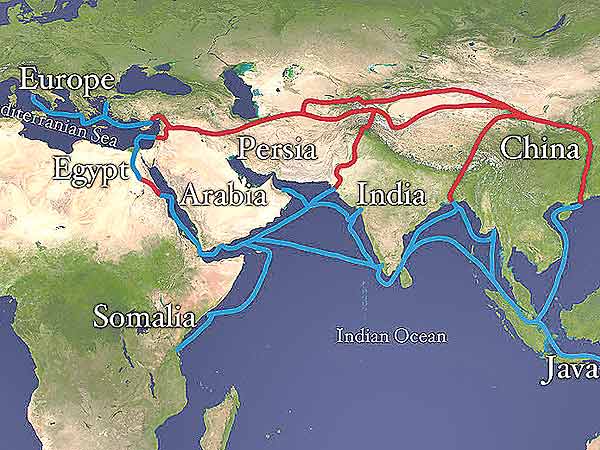
Traders, pilgrims and travellers

Article Source : http://www.ekantipur.com

  Recent archaeological discoveries of the Mustang cave civilisation and ancient civilisations of the Sakyas, Kolis and others in the western Tarai region of Nepal provide substantial evidence of the use of Nepali territories by ancient traders.

   There is no doubt that Kathmandu valley was never used as a part of the silk route but it was used by the traders and travelers as a transit point to go to Tibet and China. It was also used to go to Gandhara via Benaras, Mathura and Taxila by the Kushans.
We know that the silk route was used by the Buddhist pilgrims and traders for long. Buddhism, which flourished in the valley since the beginning of its history, might have played a role in linking Buddhist pilgrims and traders.
Since ancient times, the Western Mediterranean had trading contacts with the oriental world which were more intense than we could imagine. They took place along the caravan routes through Central Asia, and the maritime routes across the Red Sea and the Indian Ocean. India, because of its geographical position, played a role in commercial trading and cultural exchange between the East and the West. The centuries-old commercial and cultural contacts of Nepal with India might have encouraged Nepal not only to trade with India and the Western world but also to enrich its culture. Since ancient Nepal was also famous for its woolen goods, herbs, timber, precious stones and so on, If Indian spices were popular in Roman cuisines such as cardamom, nard, pepper, ginger, sesame and musk, there are possibilities that some might have gotten there from Nepal. 

  The ancient pilgrimage and trade routes from the Kathmandu valley to mainland China via Tibet is not well recorded. But we know that at the time of Lichchavis, the valley had a commercial and cultural relationship with Tibet and China. The road used by these early pilgrims and monks was also used by the traders. The Chinese Ambassador to India in the court of King Harsha Vardhan in 643 AD, Li-y-Piao came to Nepal and he was warmly welcomed by King Narendra Deva. It was at the same time that the famous Chinese businessman cum traveller Wang-Huien-Che visited Nepal.

  Among the famous visitors, in about 10th century, Gyanendra, a Tibetan saint came to Nepal to meet Acharya Santi-Rakshita. On the request of Gyanendra, Archarya Santi-Rakshita went to Tibet and again came back to Nepal after some time. According to Tara Nath, who’s written a book called History of Buddhism in India”, Vasubandhu went to Nepal accompanied by a thousand disciples in the 5th century. When King Deva Pala was ruling Bengal in the 9th century, Vajra Deva, a highly successful bard had visited Nepal and so did Samanta Bajra Deva belonging to the court of the King Deva Pala of Bengal.
During 11th century Nepali scholars like Bhiro Chana, Ratna Kriti, and Kanak Shree were at Vikram Sheel University of Bihar for studies. At that very time about 300 Chinese laborers went back to China via Nepal from the kingdom of Magadha which was under the Palas during those days. Some of these visits were in pursuit of safety. After the death of King Rathika Sena in the middle of the 12th century, Turks invaded Bihar and Bengal. They destroyed Vikramasila and massacred many ordained monks in Odantapuri. To save himself from this Muslim onslaught Acharya Ratnaraksita went to Nepal. After the Muslim devastation of Nalanda and Vikram Sheel universities of India in about 12th century, Sakya Shree Bhadra also came to Nepal. It was the time when Kubla Khan was the emperor of the Mongolian empire. 
The most famous among Nepal’s travellers at that time was probably Araniko. A group of Nepalese artists under the leadership of Araniko went to China and there they constructed numerous monuments including the famous White Pagoda. All these accounts have proved that the routes between the Kathmandu valley and Tibet and those to India were very much in use during those days. 
But the routes between the Kathmandu valley and India (either Benaras or Pataliputra or Patna) were also not well documented until the time Colonel Kirkpatrick arrived in 1793. Kirkpatrick’s account was perhaps the first scientific documentation of the routes which was used later on by numerous other British missions. Most probably, it was the same route used by the Indian and Nepali traders and pilgrims since time immemorial. The route he followed from Segouly to Kathmandu may still sounds familiar, with names like Doon-baisi, Markhoo,Chitlong, Bheem-phede, Cheesapani-fort,  Hettowara, Bechiacori, Muckwanpoor-mari and Jhuhurjhoory. From Segouly one can easily touch the Grand
Trunk Road. The inscription of King Udayadev of the 7th century AD found at Chitlong has indicated that it was one of the main villages even during the Lichchavi period. The Lichchavi inscriptions found at Tistung, the next door village of Chitlong gives further evidence that it was from this point or village numerous Nepali goods such as iron, copper utensils, wool, tails of yak and musk were exported even during the time of the Lichchavis.
Therefore, for the time being, we can conclude that the Nepal valley was connected to the Silk Route via Grand Trunk Road built by the Mughal ruler Sher Shah in the middle of the 16th century. This road was connected from Peshawar to Bengal. From Muckwanpoor a section of this Grand Trunk road via Mughalsarai can be reached very easily. From there, the connections with Benaras, Mathura, Delhi, Lahore and Peshawar were also not difficult. The connection of Kathmandu valley
to the Silk Route through the Grand Trunk Road and the ancient trails from the valley to Tibet is certainly a romantic and thrilling subject of further research by scholars. 

Shaphalya Amatya is former Director General of the Department of Archaeology, Tribhuvan University.

Friday, October 14, 2011

Culture And Tradition

Way to my village : Day 1 
 
" Aayo Dhashain "


    Dashain is National Festival of  Nepal. There is no Nepali people who don't know about Dashain. Every kids knows about it, even they get excited in this time of the year. Just the word "Dashain" can bring smiles of happiness in Nepali people :) because dashain means end of stress, sadness, unhappiness, everything. It brings joy and pleasure to kids, love and care to parents and respect to elders and fore fathers.
In Dashain we put "Tika" in our fore head from our elders as a sign of love and care. This moment just comes once a year so it is very important moment for us.
 Dashain is also like a short vacation. No one goes for a work. No one goes to school. Every one just enjoy around as much as they can.

 So i also utilized this short Dashain vacation by visiting my Village BHOJEE VDC -5 / Lamjung / Nepal 2011. Above picture is of my village. I took it when i reached my village as they were making that bamboo swing for Dashain.  

Making Swing using  Bamboo 
...........

Ready to Play 

Playing Bamboo Swing : Video Clip


Know more about Dashain from Visit Nepal : Click here

Tuesday, September 20, 2011

SANOG XVIII in Pokhara

South Asian Network Operators Group
 A non-profit forum for Data Network Operators in South Asia

About SANOG XVIII
SANOG is being hosted in Nepal for the fourth time, but for the first time in Pokhara at hotel Pokhara Grande. One of the Beautiful city of Nepal. This is the only major International networking technologies event in Nepal. During this SANOG, a special workshop on remote and rural wireless technology was organized. Pokhara is a short flight away from Kathmandu, which has easier access to most of the region, and no visas are required for people from the SANOG region, making it one of the most popular SANOG Venues over the years.
  
Director of IPv6 strategy, Hurricane Electric - Martin Levy was available in the event during the conference. His presentations were really exciting.
 
There were lost of hard working participants and the event was a great success. There were also many foreign instructors.


Tuesday, August 16, 2011

How To Quiet Rat Brain

All man’s miseries derive from not being able to sit quietly in a room alone…Pascal

It doesn’t matter what you call it—rat brain, old brain, limbic brain, monkey brain, emotional brain.  Thirty years ago, I decided to call it the rat brain, so let’s go with that.  This is the part of your brain that causes you to make irrational decisions in the heat of the trading day. This is particularly true when we are in highly volatile markets such as those that I expect to occur for the remainder of 2011.

Your rat brain instills fear and blinds you to opportunity. Your rat brain fills you with greed and blinds you to danger.  This is the part of your trading brain that must be both understood and tamed if you want to take your trading to higher and higher levels of success.

The rat brain delights in filling you with flight of ideas, endless chatter, rapidly changing thoughts and mixed messages that that cause you endless confusion. The incessant chatter can be exhausting.  Eventually you may feel like your head is going around in circles, that your

thoughts are upside down and you are exhausted, drifting on a path to nowhere and then in the depths of depression or anxiety because you can’t turn down the noise.  It’s like a reality show/soap opera filled with drama, pathos and endless cliff-hangers.  You are fighting with and within yourself.  No matter how hard you try, you are so captivated that you can’t change the channel let alone turn off the TV!  The rat brain loves this.  It adores putting you into such a state of confusion that you end up doing—for lack of a better term---rat-brained activities. These may feel OK in the moment, but they end up causing untold grief and suffering.

Examples of such activities in trading include taking profits too soon, trying to pick bottoms or tops, trading what you think (not what you see), getting into positions without a plan, letting losses run, talking yourself into and out of positions, being frozen and unable to take setups, feeling upside down and all around, and committing almost every trading error under the sun.  This has happened to me and it has happened to you. My greatest challenge in trading was to learn to control my rat brain because it truly was holding me back from being the trader I knew I could be.  After years of struggling with these impulses that seemed to come suddenly and from a place that I did not understand, I found the answer to the question:  How can I quiet my rat brain so that I can achieve my full potential as a trader?

The answer was meditation.  In my opinion, this is the best way to truly tame the rat brain.   Like trading, meditation is simple but it is not easy.  One of the most difficult things for human beings to do is nothing.  Just sit and do nothing.  It’s like that saying:  Don’t just do something—sit there.  Easy to say but really challenging to do.  The ultimate goal of meditation is to be centered.  When you are in your center, you are at the ultimate point of  silence, balance and clarity..  Meditation is both a natural and a surrendering technique.  It is one of trust and inner release.

There are many ways to meditate. I have found a way that works for me and have taught it to a number of traders. This technique may or may not be right for you, but I have found that it resonates with many traders at all skill and age levels.

You may want to begin by focusing on the breath while you meditate. Whenever your rat brain starts getting “chatty,” observe your thoughts, let them drift down gently like leaves falling softly from a tree and landing without sound on the ground.  Continue to focus on the breath.  Soften your eyes and feel them falling down into their sockets.  Turn the eyes and the ears inward to watch the breath.  As you go more deeply into meditation, turn all of your senses inward to watch the breath and feel your brain soften and become a distant observer. 

With time and practice, you will look forward to those precious times of meditation.  They will be a good habit and an integral part of your life.  Your world will become more vivid and you will become more awake, alive, vital, responsible and effective---both in and out of the markets.

We sit around in a ring and suppose.  But the SECRET sits in the middle and knows…Robert Frost.


Janice Dorn, M.D., Ph.D.